Killing for Justice
Camus on how far revolt should go

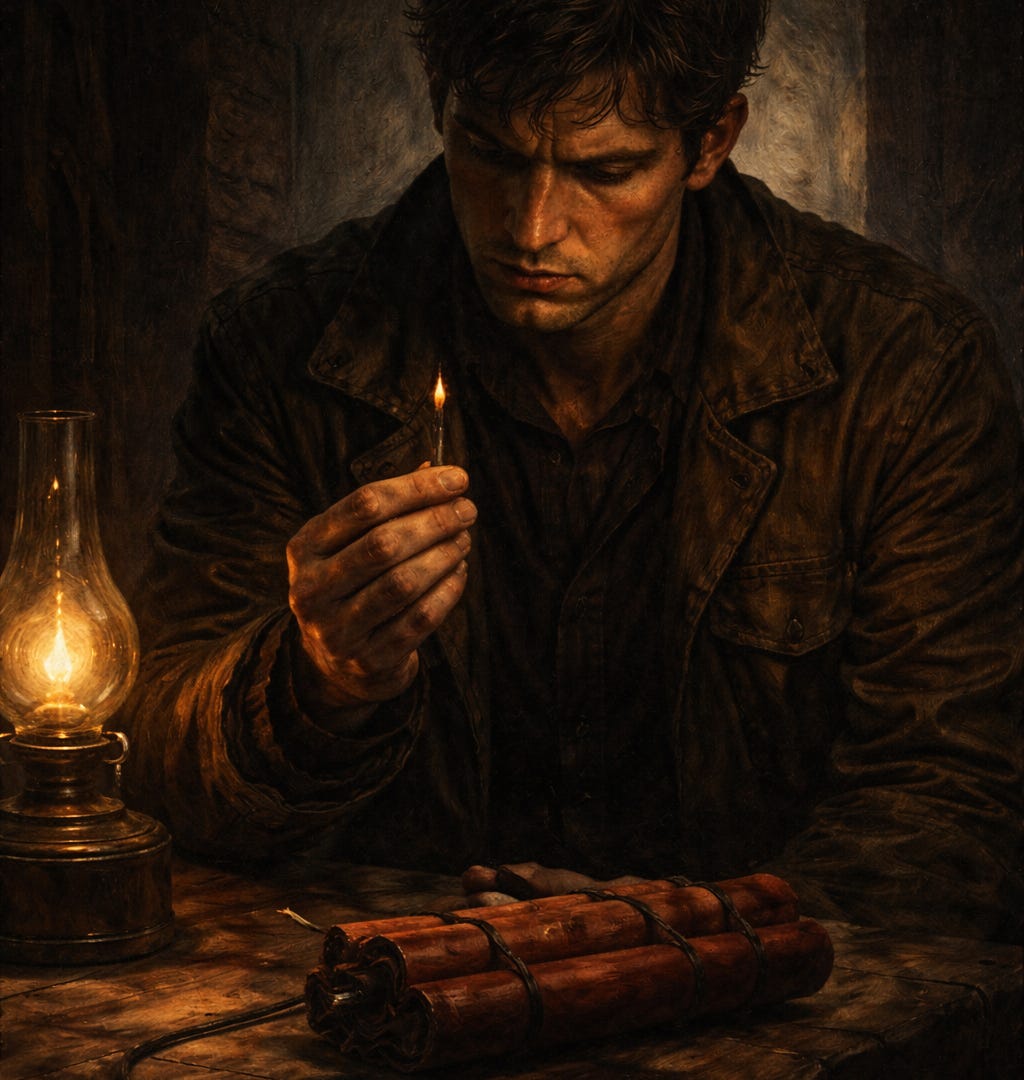
[This is the eighteenth entry in my Camus series, adapted from my dissertation. The level of revision is evolving, so feel free to share thoughts or merciless pushback in the comments.]
We’ve reached the point of this journey where I must now answer a completely fair question: What does any of this actually tell us to do? What’s the practical cash value of Camus’s political thought?
We’ve been living inside Camus’s conceptual world. I’ve written a ton about how Camus insisted, again and again, that the human condition doesn’t give us final answers, that history doesn’t provide moral absolution, that the hunger for certainty is itself one of the great dangers of modern politics. That’s all good and important stuff. But at some point the conversation has to become concrete and offer some kind of guidance for the choices we make in the political arena. Or at least it has to do this if it’s going to be useful outside the library.
So if revolt doesn’t give us definitive rules for action, if it resists clear standards and refuses ultimate justifications, then what kind of ethics can it really support in the world as it is? And if revolt is said to create value rather than discover it, why should anyone else feel bound by the values I affirm?
These are the questions that decide whether Camus’s political thought is a living resource or just a collection of very pretty thoughts.
It seems a lot of people think it’s the latter. His refusal to take sides, his skepticism toward ideology, his reluctance to endorse programs or movements can all start to look like evasiveness. It’s a fair reaction. If you need someone to declare himself in that way, or pick a team, or announce a final moral stance, Camus will disappoint you. He doesn’t offer a blueprint. He doesn’t tell you which revolutions to support or which regimes to overthrow.
And look, we can just admit that this is kind of annoying. But I do think there are reasons why Camus does this and I’ll try to walk through them in this post.
The complaint that Camus won’t give us a guide
A common objection is that Camus’s thought is too vague or too unsystematic to guide action. Ronald Srigley has argued that Camus’s “methodological skepticism” constrained his analysis because it prevented him from exploring experiences that went beyond the limits his presuppositions prescribed.
There’s no doubt a kernel of truth there. Camus really does refuse to go beyond those limits. But I don’t think that refusal is a failure of courage. I actually think it’s what makes his political thought coherent.
Camus does not go beyond the bounds of his presuppositions because that would exceed the limits marked by absurdity. Absurdity is like an epistemological boundary in Camus’s world. It’s the recognition that we do not have access to ultimate knowledge about reality, purpose, destiny, the direction of history, or the ultimate meaning of suffering.
If you accept that recognition (and I think you should), you can’t then build politics on metaphysical certainty. You can’t take refuge in a grand narrative and pretend that your actions are sanctified by history. You can’t claim to know what the future demands from the present.
Camus advocates skepticism for a very specific reason. Ideas, especially big ones, give intellectual cover to violence. Ideas about God, about history, about human nature. Ideas that claim to see the whole. They make it possible to do terrible things while feeling morally clean.
That’s why Camus resists claims to ultimate truth. Not because he thinks truth doesn’t exist, and not because he wants to live in permanent uncertainty for its own sake. He resists the kind of truth claims that turn politics into a religion.
That doesn’t mean Camus is closed to experiential truth. It means he wants truth tethered to experience, not floating above it. And that’s why he increasingly turns to art and fiction. It’s the medium through which he can reinvigorate experiential truths that can’t be systematized.
The complaint that Camus won’t commit politically
There’s another critique that’s more political in tone. The idea that Camus’s unwillingness to commit rendered his thought practically insignificant.
Tony Judt makes a version of this argument in The Burden of Responsibility. He treats Camus as important, but largely unpolitical. “Not unconcerned with public affairs or uncaring about political choices,” Judt writes, Camus was nevertheless “by instinct and temperament an unaffiliated person.”
So the story becomes, Camus cared but couldn’t commit. He felt the moral pull but wouldn’t get his hands dirty. He was too ambiguous to be politically useful.
Sartre, of course, took the same basic charge and went even harder on Camus, who up to that point was a close friend. After The Rebel was published, Sartre dismissed Camus as unclear and ahistorical. He thought Camus’s political philosophy failed to address historical conditions amounted to “an abstract, introspective search for principles to solace our metaphysical unhappiness.” So Sartre accused Camus of mistaking metaphysical discomfort for politics.
Sartre approached revolt from the perspective of the worker. Revolt, for him, is a response to material conditions. It emerges from exploitation, from inequality, from economic and political transformations. That’s why he insists, against Camus, that “The circumstances which bring about the crystallization of the masses into revolutionary mobs can with good reason be called historical.”
To Sartre, Camus’s focus on metaphysical revolt is a dodge. It isn’t that Camus is wrong to care about suffering. It’s that he’s wrong to begin there.
And then you get Andre Breton’s critique, which is less philosophical and even more contemptuous:
What is this phantom of revolt that Camus is trying to credit, and behind which he takes shelter, a form of revolt into which moderation has been introduced? Once the revolt has been emptied of its passionate substance, what could possibly remain? I have no doubt that many people will be duped by this artifice: it is a case of keeping the word and eliminating the thing itself.
Breton is essentially saying that Camus is selling a harmless revolt that lets readers feel morally serious without requiring any serious action.
Even if you think Breton is being unfair, the question underneath the sarcasm is real.
Without a willingness to take extraordinary action, what becomes of revolt? Is it possible to impose limits retroactively on something that, in practice, often arrives as excess? Can revolt remain revolt if it’s moderated?
Camus understood this question. He also knew that his answer would never satisfy the people who wanted revolution to be a moral absolute.
What Camus was trying to stop
This is where I think Camus’s intentions are often misunderstood, sometimes deliberately.
Camus’s first concern was not to design a revolutionary ethics. It was to undermine the theoretical justifications for violence that were everywhere in his intellectual environment. He was disturbed by the capacity of intellectuals to justify crime on ideological grounds and treat murder as a historical necessity.
That’s a pretty big point.
If you read The Rebel as a political program, you’re going to be disappointed. That’s not what it is. It’s an intervention against the metaphysical and historical alibis that make limitless violence possible.
Camus was drawn to figures like Ivan Karamazov for a reason. Ivan’s revolt begins as a moral protest. It refuses to accept a world in which innocent people suffer. But Camus also understood that metaphysical revolt can become a negation of reality. It can become a refusal not only of injustice but of the world as it is. And once you refuse the world, it becomes easier to destroy it in the name of a better one.
This is why Camus is wary of Sartre’s insistence on historicizing action. To historicize action is to separate it from immediate experience. It divorces the rebel from absurdity and forces him into a position in which his rebellion depends on his non-recognition of reality. He has to live in and constantly reorder the false world he has created.
That’s a consequential mistake for Camus. It sets up a conflict between reality and the system claiming to explain it, and too often, Camus believes, it’s reality that must give way. The living, the concrete, the particular are sacrificed to preserve the coherence of the theory.
And that’s the moment Camus is describing when he writes that “rebellion, forgetful of its origins… denies life, dashes toward destruction, and raises up the grimacing cohorts of petty rebels.”
So Camus is not primarily interested in defining revolt. He starts from the observation that revolt, whatever its origins, can lead either to solidarity or suffering. He’s trying to defend the former against the latter.
And once you see that, his refusal to offer clear standards looks more like an attempt to make politics answerable to human limits.
A different kind of politics
This is where Jeffrey Isaac’s reading becomes helpful, because it captures what Camus is trying to do without forcing him into categories he never wanted.
Isaac argues that it’s a mistake to accuse Camus of ignoring history or treating revolt as purely metaphysical:
They correctly saw that the rebellion depicted in The Plague is not a class struggle, that it involves no political parties or mass movements and has neither grandiose ideological ambitions nor any deep interest in state power. But they were wrong to conclude that it therefore represents a kind of pristine and moralistic political withdrawal. Rather, it depicts new kind of politics… In no way does it abandon history. But it refuses any kind of grand historical justification like that found in Marxism… Rieux lives thoroughly in the present. This does not make him indifferent to consequences. It is just that he chooses his ends and means soberly, and justifies them not in terms of a grand narrative but in terms of an active solidarity.
This is the heart of Camusian revolt. It’s politics without metaphysical guarantees. Politics grounded in the present tense.
Dr. Rieux doesn’t pretend he knows how history ends. He doesn’t claim that suffering is meaningful in some larger story. He acts because people are suffering now and because their suffering makes a claim on him.
From an ethical perspective, Camus is not giving us rules. He’s trying to establish a pluralistic framework within which actions can be measured and judged. It lacks the certainty of metaphysical systems because life with others demands that uncertainty.
Values are self-constituted products of a political community. To be binding, they must emerge from dialogue and experience. And they must remain provisional, not because they are arbitrary, but because the only way they stay alive is through continual reaffirmation.
All of that sounds lovely and maybe even reasonable in the abstract. But the real test comes when we turn to violence.
The Just Assassins
In The Just Assassins, one of Camus’s plays, revolt is seen from the perspective of the revolutionary. Camus draws on historical events to show that even under extreme circumstances, we can’t speak of purely just or unjust action. We can only speak of action that recognizes limits.
And just to be clear, this is not a paean to pacifism. Camus does not pretend violence can always be avoided. Violence is accepted here as a necessary and indefensible reality.
Performed in 1949, the play follows an insurrectionist group planning to assassinate the Russian Grand Duke. Camus gives us a small cast, but each character is designed to embody a moral attitude.
Stephan is the absolutist. He refuses to impose limits on action. Kaliayev is the compassionate rebel, the one Camus wants us to take seriously. He opposes all attempts to rationalize murder. Dora is the conscience. She’s constantly reminding the others that there are moral limits that cannot be transgressed without destroying the meaning of their struggle.
The tension among these characters reflects the dynamic between rebellion and revolution. It highlights the balance the rebel must strike between a demand for justice and a refusal to justify murder.
Stephan and Kaliayev represent opposing moral universes.
Stephan is the revolutionary as Camus fears him. He’s completely certain. He has no patience for doubt. When the group hesitates about sacrificing children, Stephan erupts:
There are no limits! The truth is that you don’t believe in the revolution, any of you. No, you don’t believe in it. If you did believe in it sincerely, with all your hearts; if you felt sure that, by dint of our struggles and sacrifices, some day we shall build up a new Russia, redeemed from despotism, a land of freedom that will gradually spread out over the whole earth; and if you felt convinced that then and only then, freed from his masters, and his superstitions, man will at last look up toward the sky, a god in his own right – how, I ask you, could the deaths of two children be weighed in the balance against such a faith? Surely you would claim for yourselves the right to do anything and everything that might bring that day nearer!
When Camus calls revolutionary ideologies “frustrated religions,” this is what he means. Stephan rejects God but cannot let go of transcendence. He simply relocates transcendence into history.
For him, “the future is the only transcendent value.” Once the future becomes sacred, the present becomes expendable. And once the present becomes expendable, anything becomes possible.
Stephan also rejects limits. He’s the pseudo-humanist Camus associates with certain forms of socialism, the one who “rejects the man of today in the name of the man of the future.”
And his aspirations are totally utopian. Against absolute despotism he seeks absolute freedom. This the “all or nothing” attitude Camus condemns in The Rebel.
Stephan’s mindset resembles Verkhovensky in The Possessed, who offers a defense of unlimited action in the name of a future freedom:
I ask you which you prefer: the slow way, which consists in the composition of socialistic romances and the academic ordering of the destinies of humanity a thousand years hence, while despotism will swallow the savory morsels which would almost fly into your mouths of themselves if you’d take a little trouble; or do you, whatever it may imply, prefer a quicker way which will at last untie your hands, and will not let humanity make its own social organization in freedom and in action, not on paper.
The logic is the same. The future justifies the present. Limitless action becomes not only permissible but morally necessary.
Kaliayev, on the other hand, is defined by doubt. But it’s the doubt of someone who acts while knowing he might be wrong. Here’s what he says to Stephan:
Quite likely you are right. But those I love are the men who are alive today, and walk this same earth. It’s they whom I hail, it is for them I am fighting, for them I am ready to lay down my life. But I shall not strike my brothers in the face for the sake of some far-off city, which, for all I know, may not exist. I refuse to add to the living injustice all around me for the sake of a dead justice… Killing children is a crime against a man’s honor. And if one day the revolution thinks fit to break with honor, well, I’m through with revolution.
Kaliayev recognizes injustice and he’s prepared to die, but he won’t sever his action from the living people it’s supposed to serve. That’s basically Camus’s political sensibility. Kaliayev’s revolution is not a transcendent end. It’s a means, to justice, to peace, to life. And because it is only a means, it can’t justify anything and everything.
Camus writes that “Kaliayev doubted to the end, but this doubt did not prevent him from acting; it is for that reason that he is the purest image of rebellion.” We often think purity belongs to the uncompromising but Camus thinks it belongs to the one who refuses to lie to himself.
The third character, Dora, mediates the struggle between Stephan and Kaliayev and worries that what they are doing will ultimately prove self-defeating.
“Nobody,” she worries, “will want to look justice in the face again.”
Dora is willing to adopt violence, but only up to a point. She believes that to go too far is to betray the people in whose name they fight. Just as Ivan thinks suffering is too high a price for salvation, Dora thinks murder is too high a price for justice. If you accept it, she says, it means “you have gone about it too fast… you are no longer men.”
Imposing limits on violence
This brings us to Camus’s conception of political violence, which is a tad controversial. He distinguishes between two accounts of violence, bourgeois and revolutionary.
Bourgeois violence is, in John Foley’s formulation, “the refusal to recognize one of the terms of the dilemma highlighted by political violence.” It involves condemning direct violence while sanctioning “that diffuse form of violence which takes place on the scale of world history.”
This is the violence of clean hands. The violence of intellectuals who can justify killing as necessity while never leaving their armchairs. Camus has in mind figures like Sartre, who were prepared to endorse violence in theory, but who would never have to carry out that violence themselves.
Revolutionary violence is the opposite error. It’s the categorical embrace of violence as a political instrument. Those who adopt this account, Camus argues, “console themselves, in the name of history, with the thought that violence is necessary, and will add murder to murder, to the point of making of history nothing but a continuous violation of everything in man which protests against injustice.”
Revolutionary violence is murder theoretically excused. The Machiavellian realism that separates moral considerations from political calculation.
In The Just Assassins, Camus tries to offer up a different moral calculus.
What distinguishes Kaliayev and Dora from more nihilistic revolutionaries is that “from their earliest days they were incapable of justifying what they nevertheless found necessary, and conceived the idea of offering themselves as a justification and of replaying by personal sacrifice.”
This is the origin of Camus’s life for a life thesis, the idea that a rebel must be willing to die if he is willing to kill.
Self-sacrifice is the thing. It limits action in the present and preserves the value of life in the future, because it refuses to let killing become easy or morally normalized.
“I fear for the future,” Dora says, “others, perhaps, will come who’ll quote our authority for killing; and will not pay with their lives.” That’s the fear that moral seriousness will be replaced by moral convenience and that violence will become a habit.
Now, we have to acknowledge that the life for a life thesis is muddled. As a practical matter, what does it mean to offer your life as justification for killing? Critics charge Camus with advocating an incoherent and impracticable solution to political violence. Others argue that he rejects all recourse to violence in the name of abstract humanism.
But those critiques misunderstand his intention. Camus is not laying down a blueprint for revolutionary action. He’s trying — and I emphasize “trying” — to cultivate a rebellious attitude that values life more than ideas.
The life for a life thesis is not a literal policy. It’s a reminder that murder and rebellion are fundamentally incompatible, and that any act of killing is a rupture that must be paid for, not rationalized away.
Legitimate violence in Camus’s fiction
Camus gives us examples of what he considers legitimate violence.
Kaliayev kills only after the strictest self-examination. He refuses to kill when children are present. But what makes him the “purest image of rebellion” is what he does afterward.
He’s arrested immediately. And once captured, he doesn’t try to escape. He accepts responsibility, even refusing a pardon.
“I am ready to pay the price of what I’ve done,” he says.
Kaliayev knows he has committed an indefensible crime. He admits his guilt and endures what he must. But he refuses to repent because he believes his act was made in service of a higher value.
“I threw the bomb at your tyranny, not a man.”
The problem here is that he’s trying to separate the person from what he represents as if that makes it more clean. Camus thinks it doesn’t, which is why Kaliayev pays for his uncertainty with his life. He affirms a value, but refuses to treat his judgment as final.
The second example is Caligula.
Cherea explains his decision to assassinate Caligula in a passage that captures as well as anything what tyranny does to ordinary life.
I’ve told you why; because I regard you as noxious, a constant menace. I like, and need, to feel secure. So do most men. They resent living in a world where the most preposterous fancy may at any moment become a reality, and the absurd transfix their lives, like a dagger in the heart… I’ll be no party to your logic. I’ve a very different notion of my duties as a man… I don’t hate you. I understand, and, to a point, agree with you. But you’re pernicious, and you’ve got to go.
Cherea is hardly a romantic revolutionary. He wants a world in which life is not constantly threatened by the arbitrary power of one person.
Caligula’s madness makes it impossible for others to live. His actions are an affront to dignity. Cherea decides it’s worth risking his life to end them. But he also knows that an assassination is not just an act. It is a symbol that communicates something about what’s permissible.
That’s why he tries to convince honorable men to join him. It’s the only way the act can be creative of value and ensure others will take his place if he fails.
I think Camus’s criteria for legitimate violence are pretty clear in these examples. First, they accept death. Kaliayev dies. Cherea and Scipio are willing to die. That willingness matters more than the outcome because it signals that they don’t treat killing as a morally cost-free act.
Second, the violence is not done at a distance. Kaliayev throws the bomb himself. Cherea and Scipio kill with their own hands. They don’t delegate murder. They don’t hide behind abstraction.
Third, they target a tyrant and take real pains to spare innocents. Kaliayev aborts the attempt when children are present. Cherea and Scipio strike when Caligula is alone.
Finally, they kill as a last resort. Extreme measures come only after other options have been exhausted. This does not justify the act, but it at least reflects moral seriousness.
What Camus is really trying to build
Camus wants a philosophy of politics that imposes limits and remains consistent with the demands of absurdity.
In The Myth of Sisyphus, he invokes absurdity to establish the impossibility of absolute knowledge. He discovers “the means to proceed beyond nihilism” by rejecting suicide. Life has value if it’s lived within the limits of the human condition.
Camus’s absurdism nullifies the epistemological basis of ideologies. It’s also a declaration of human innocence, in the sense that the absurd defines a condition shared by all. That shared condition becomes a source of communion and an imperative to serve those with whom it is shared.
In The Rebel, Camus transfers the limits marked by absurdity into the political realm. Action is constrained by experiential factors. Foundations must remain relative and provisional because they exist only insofar as they are continually reaffirmed in experience.
So the critique that Camus fails to offer a guide to revolutionary action misses his intention. He’s responding to the plague of nihilism.
“The world that people like me are after,” Camus wrote, “is not a world in which people don’t kill each other… but a world in which murder is not legitimized.”
Nietzsche, Dostoevsky, and the pendulum of Camus’s thought
We can wrap this up by returning to our old friends, Nietzsche and Dostoevsky.
In the revolt period, Camus is both converging with them and trying to move beyond them. The worldliness of Nietzsche becomes, in Camus, an experiential ground. Revolt tries to realize itself “from bottom to top.” Experience remains the primary thing.
But Nietzsche’s rejection of idealism and his exaltation of becoming can lead to action without limits. That’s where Camus exits the Nietzsche train. Deprived of a moral counter-force, Nietzsche’s world is propelled by affirmations of power and will. In the political realm, that logic can become a kind of circularity without direction.
Camus says that Revolution retains the meaning it has in astronomy. A movement that describes a complete circle. Revolt, by contrast, reverses the movement. It leads from individual experience into the realm of ideas.
And then Dostoevsky. One of the core claims in my dissertation is that Camus moves pendulously between Nietzsche and Dostoevsky. Nowhere is that clearer than here.
In The Rebel, Camus’s divergence from Nietzsche is almost inversely proportional to his convergence with Dostoevsky. He invokes Ivan’s “everything is permitted” to highlight the danger of Nietzschean logic, or at least the danger of a world in which value collapses into power.
Dostoevsky’s arguments about values and foundations influence Camus’s mounting concern with limits. Camus can’t preserve Dostoevsky’s Christ-ideal and he can’t accept transcendence. But he does attempt to preserve the sense that without limits, politics becomes inhuman.
So he posits an experiential basis for limits, values, and solidarity. It’s not a perfect substitute for transcendence. It is, in view of absurdity, the most his political thought could hope to accomplish.
Thanks for reading. If you’re getting value from this series, consider sharing or, even better, subscribing, or even better than that, becoming a paid subscriber!