
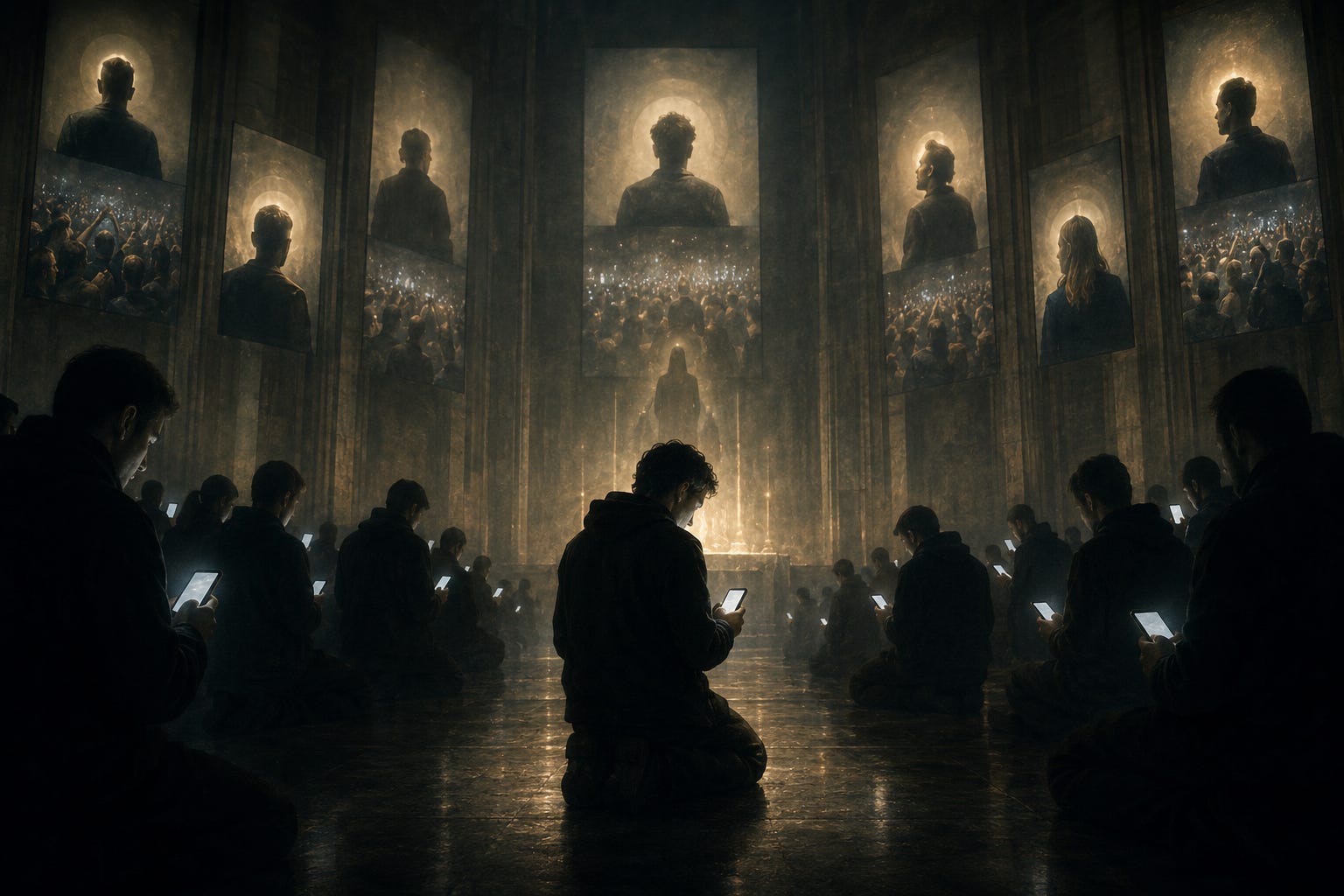
When I had to justify my dissertation to my political science committee, I told them the thing was about what happens to societies when the sources of meaning and authority collapse. Which is a perfectly legitimate question for political theory.
If you’ve been following along here, you have a good sense of where I went with this. Nietzsche was the one who made the problem impossible to ignore. All the “God is dead” business was an attempt to deal with the cultural and political crisis created by the breakdown of religious metaphysics.
The question, for me, was not whether the pre-secular world was better than this one. Maybe I don’t need to say it, but I’ll say it: Secular societies are better and freer. All I’ve ever suggested is that the decline of religious institutions had a higher cost than secular-minded people are comfortable admitting.
The religious impulse is deep and unkillable and people are going to satisfy it one way or the other. If politics is the place they go to find it, that’s a big problem. And this isn't the culture war routine where wokeness and MAGA are dismissed as dueling religions, though there’s something to the comparison. It’s the deeper stuff underneath that I find so interesting.
Camus’s The Rebel is an admittedly flawed book but it’s invaluable as a work of political theology. It’s as good as anything I’ve read at showing how totalitarian ideologies became horizontal religions. Replacing God with History and dragging the whole redemptive drama down to earth. I’ve written a bunch about this already so I won’t tumble down that rabbit hole here.
What I will say (and this is, just, like, my opinion) is that empirical social science doesn’t have a reliable way to deal with this reality of human nature. People aren’t like billiard balls and political science will never be a hard science. We’re extremely weird, emotional creatures with irrational needs and a pathological desire for coherence and freedom. That’s just a basic starting point for thinking about political life.
Probably the main reason for my attraction to Dostoevsky is that he’s so good at exploring all the contradictions of human behavior. There’s a memorable bit in Dostoevsky’s Notes from Underground (a book begging for a modern remake) where the protagonist says, “I agree that two times two makes four is an excellent thing; but if we are dispensing praise, then two times two makes five is sometimes a most charming little thing as well.”
Really that whole book is about how our psychological needs can be so at odds with our physical reality. It’s like there’s this part of the human psyche that will insist that 2 x 2 = 5 not because it’s true but because “fuck you.” It’s stupid for sure, but Dostoevsky’s point is that humans will rebel against anything — including reason and logic — in order to assert their own freedom. This is the stuff I think about when I look at politics, which I do for a living, which is either a vocation or a disorder depending on the day.
So what’s this have to do with Nietzsche and the death of God? Any ideology worth its salt has a way of organizing the world for us. Not hard to see the appeal here: The world’s a mess and anything that sorts it out is incredibly seductive. Accepting ambiguity sucks and a good ideology means you don’t have to.
Problem is, to Dostoevsky’s point, people also hate being organized. The same guy who wants the world explained will blow up the explanation just to prove he can't be predicted. Say what you will about the totalizing 20th century ideologies, they were at least internally consistent. They were systems that had to hang together.
Modern politics is considerably stupider. I don’t know that there are any real ideologies anymore. We seem to have zipped past that stage of political history. No more grand theories of history, no highfalutin metaphysics. Nowadays you just have to get the vibes right. I know a slice of the online right is doing something approximating metaphysics (I wrote about it recently) but it’s downstream of maybe a few thousand people. By the time it reaches the rest of us it’s been thoroughly memeified.
A lot of this is just the reality of life in the digital era. Everything is mediated, everything is scattered, everything is encountered as content, especially politics. If you’re isolated and looking to politics for meaning or community, you’re unlikely to find it. What you end up with is the dumbest possible religion — a half-baked combination of shitposting, virtue-signaling, and hobbyism. Which somehow allows for the same religious fervor without any of the good parts — ritual, transcendence, community.
Like, I’m genuinely curious why political identity seems to be the primary cultural marker in American life right now? Is it because it’s the only game in town? Nearly everyone — and I do mean everyone — in my life has extremely loud political views. And if I know how they vote, I can almost certainly tell you what they drive, what they watch, where they get their news, and what they think about basically everything else. Whatever markers existed before have been folded into the red-blue thing. That's a shit ton of cultural power for a religion this dumb.
Ironically the shallowness may be the reason the stakes feel so high. A doctrine, after all, is a thing outside of you. It makes claims about the world and if it turns out the theory of history was wrong you can put it down and go get a different one. Identity is a different thing, a more personal thing, an attack on who you think you are. People today still switch their identities, maybe more than they ever have. It feels much flimsier to me, like people changing their tastes, not their minds. Again, it’s identity in the shallowest possible sense.
If you asked me if my politics are my identity, I’d say no. A lot of people would give the same answer, though. I get paid to treat politics as the most important thing happening on any given day and it turns out that isn’t so different from believing it. But then I go downstairs and one of my kids is melting down because the wrong cup was placed on the table. Or the dog needs to go out again. Point is, life’s always happening right in front of us and there’s always stuff to do. All of that shit is more real and grounding than the arguments in your head.
Luckily, this isn’t a journal essay so I don’t have to land the plane here. Almost everything I scribble these days amounts to a complaint about the shallowness of modern life. Not sure what the alternatives are supposed to look like at scale. People need what they need and I'm honestly out of ideas about where they're supposed to get it.
I'll throw it to you, since you're the closest thing this blog has to a congregation: Where do you get yours? What’s a more healthy orientation to politics? Does politics as dumb religion sound vaguely right? Is there anything here worth exploring?
If you’re enjoying these scribblings, please consider sharing or, even better, subscribing, or even better than that, becoming a paid subscriber!
As you’ve alluded, part of the question is about community and meaning. Places I find it:
1. Volunteerism. I’ve served on the board of various non-profits. You don’t have to be on the board. You can just be involved in something — making the school better, cleaning up trash in the neighborhood, restoring the American chestnut, teaching people to knit.
2. A making hobby. I’m into fiber arts — knitting, crochet, spinning weaving. Other people I know are into 3D printing or model airplanes or restoring automobiles. There is a project with a start, middle, and end. They build skills as well as something physically satisfying.
3. Gathering. Gather for non-political reasons. Get together to play tabletop games or bridge or mah jong. Go to Pennsic or Dragon Con or Burning Man or a Mensa annual gathering. Invite the neighbors over for a cookout.
What all these things do is get you interacting with other people about common causes. Instead of arguing about politics, you are working cooperatively. You are complimenting each other. People used to do this once a week at a religious service. Go out and make some oxytocin and help others make some, too.
Great essay. Very welcome subtle Lebowski references.